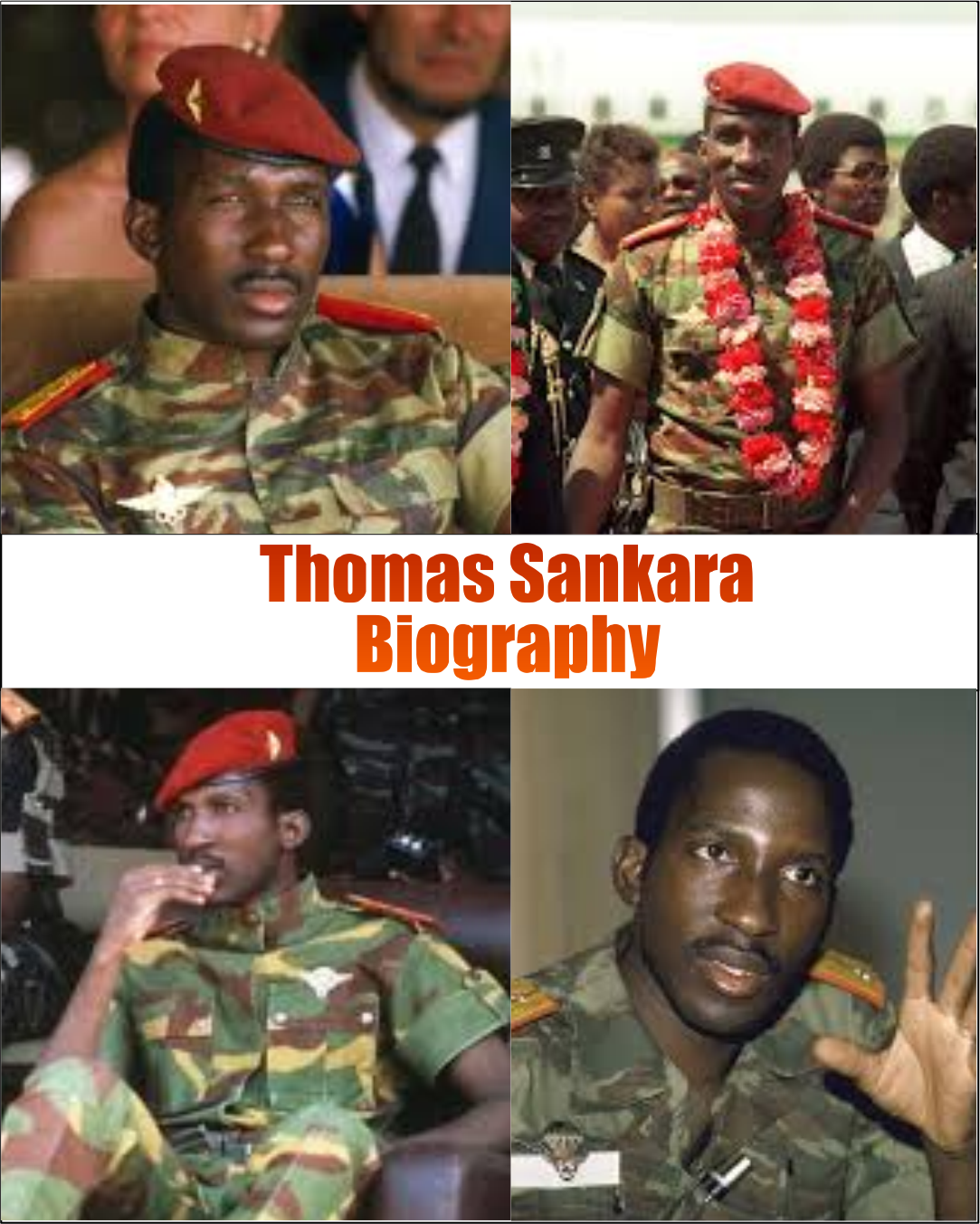
Thomas Sankara Biography
The Thomas Sankara Biography: The Soldier Who Rewrote a Nation Identity.
Discover how Thomas Sankara rose from a military officer to a revolutionary leader who transformed Burkina Faso through bold reforms and radical vision.
Some soldiers fight to defend a system.
Others fight to change it.
Thomas Sankara did something far more dangerous—he tried to rebuild it entirely.
In just a few years, he challenged power structures, redefined leadership, and attempted to reshape an entire nation’s identity.
And in doing so, he became one of the most unforgettable—and controversial—figures in African military history.
Thomas Sankara Biography
| Full Name | Thomas Isidore Noël Sankara |
|---|---|
| Date of Birth | December 21, 1949 |
| Place of Birth | Yako, Upper Volta (now Burkina Faso) |
| Nationality | Burkinabé |
| Profession | Military Officer, Revolutionary Leader |
| Known For | President of Burkina Faso (1983–1987); Anti-imperialist reforms |
| Education | Military Training in Madagascar and Burkina Faso |
| Net Worth | Not publicly disclosed |
| Marital Status | Married |
See also: Benedict Oramah Biography: The Banker Who Reimagined and Reshaped Africa
Early Life and Enlistment Story
Thomas Sankara’s early life in what was then Upper Volta (now Burkina Faso) reflected a blend of discipline and curiosity.
He was drawn to the military not just as a career, but as a platform for influence.
He trained as an officer and quickly distinguished himself through:
- Strong intellectual engagement
- Leadership presence
- Awareness of political structures
Unlike many of his peers, Sankara viewed the military not just as a defense institution—but as a tool for national transformation.
Major Engagements and Rise to Power
Sankara’s military career intersected with a period of political instability in Burkina Faso.
His rise culminated in a shift of power in 1983, where he emerged as a central figure in a revolutionary government.
This was not a conventional military engagement.
It was a political-military transition—one that placed him in direct control of national direction.
Revolutionary Acts: Redefining Leadership
Once in power, Sankara initiated a series of reforms that were both bold and disruptive.
These included:
- Promoting self-reliance and reducing foreign dependence
- Implementing anti-corruption measures
- Advancing women’s rights in unprecedented ways for the region
- Encouraging local production and consumption
His approach to leadership was hands-on and symbolic.
He reduced his own privileges and emphasized accountability across government structures.
Leadership Under Pressure
Sankara’s leadership quickly attracted both support and resistance.
He faced pressure from:
- Internal political actors
- External interests affected by his policies
- Sections of the population adjusting to rapid change
Maintaining control required balancing reform with stability—a challenge that grew increasingly complex.
Survival in a Politically Charged Environment
Unlike battlefield survival, Sankara’s challenge was navigating a politically volatile environment.
Threats came not from distant enemies—but from within:
- Shifting alliances
- Internal dissent
- Power struggles among leadership circles
In such contexts, the risks are often less visible—but equally dangerous.
Psychological Struggles and the Weight of Change
Driving rapid national transformation carries significant psychological burden.
Sankara’s role required:
- Constant decision-making under scrutiny
- Managing resistance to change
- Maintaining vision amid opposition
These pressures shape leaders in profound ways, often isolating them within their own systems.
The Final Chapter: Assassination and Aftermath
In 1987, Sankara was killed during a coup that brought his leadership to an abrupt end.
His death marked a turning point for Burkina Faso.
It also reinforced a recurring reality in political-military history:
Radical change often comes with high personal risk.
Medals, Recognition, and Historical Status
While Sankara did not accumulate traditional military honors in the conventional sense, his recognition has grown significantly over time.
He is widely regarded as:
- A symbol of integrity in leadership
- A revolutionary thinker
- A figure of inspiration across Africa
His influence has extended beyond his lifetime.
Untold Stories Behind the Revolution
Many aspects of Sankara’s leadership remain partially documented.
These include:
- Internal government dynamics
- Personal reflections on his policies
- Decision-making processes during critical moments
Such gaps leave room for continued interpretation of his legacy.
Legacy and Continental Impact
Thomas Sankara’s legacy is one of transformation.
He represents:
- The possibility of radical reform
- The role of military leaders in political change
- The enduring impact of visionary leadership
His ideas continue to influence discussions on governance, self-reliance, and African development.
Memorable Closing
Thomas Sankara did not lead quietly.
He disrupted systems, challenged norms, and reimagined what leadership could look like.
His time in power was brief—but his impact was lasting.
Because sometimes, the leaders who change the most…
are the ones who don’t last the longest.
And in Sankara’s case, his story did not end with his life.
It became a reference point—for what leadership could be.
Frequently Asked Questions
Who was Thomas Sankara?
Thomas Sankara was a Burkinabé military officer and revolutionary leader who served as President of Burkina Faso and became known for his radical social and economic reforms.
Why is Thomas Sankara called “Africa’s Che Guevara”?
Thomas Sankara is often called “Africa’s Che Guevara” because of his revolutionary ideals, anti-imperialist stance, and efforts to promote self-reliance and social justice.
What reforms did Thomas Sankara introduce?
Thomas Sankara introduced policies focused on women’s rights, education, healthcare, anti-corruption, and economic independence, including land redistribution and vaccination programs.
How did Thomas Sankara die?
Thomas Sankara was assassinated on October 15, 1987, during a coup that brought his former ally Blaise Compaoré to power.
What is Thomas Sankara’s legacy?
Thomas Sankara is remembered as a symbol of integrity, leadership, and resistance against corruption and foreign dependence in Africa.