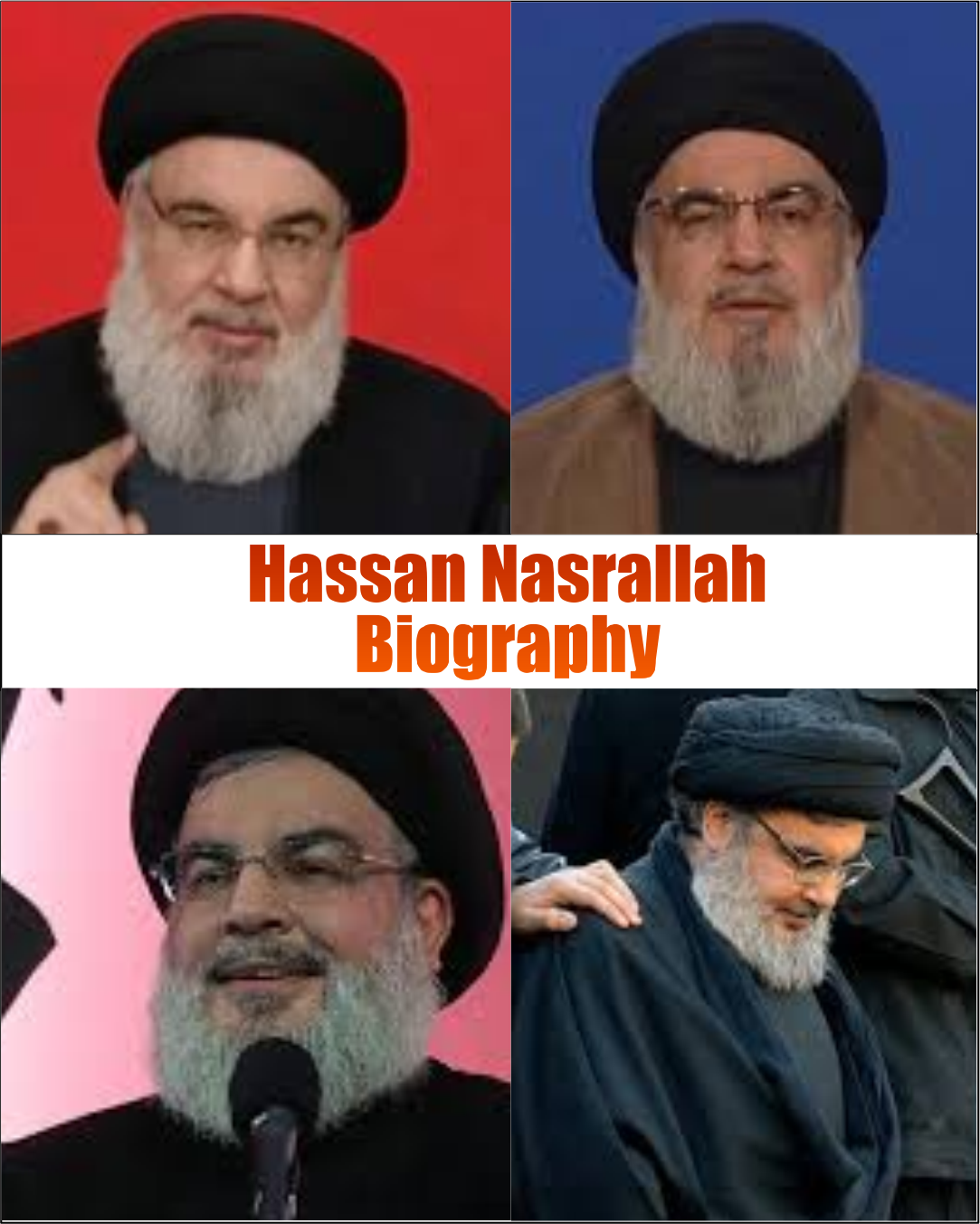
Hassan Nasrallah Biography
The Hassan Nasrallah Biography: The Underground Commander.
Explore how Hassan Nasrallah rose from clerical roots to become a key military leader, shaping asymmetric warfare and regional power dynamics.
Not all military leaders wear uniforms.
Some operate from the shadows—commanding influence, shaping conflict, and redefining what power looks like in modern warfare.
Hassan Nasrallah is one of those figures.
His battlefield is not always visible.
But its impact is undeniable.
Hassan Nasrallah Biography
| Full Name | Hassan Abdel Karim Nasrallah |
|---|---|
| Date of Birth | August 31, 1960 |
| Place of Birth | Bourj Hammoud, Beirut, Lebanon |
| Nationality | Lebanese |
| Profession | Religious Leader, Political Leader |
| Known For | Secretary-General of Hezbollah |
| Education | Religious Studies in Najaf (Iraq) |
| Net Worth | Not publicly disclosed |
| Marital Status | Married |
Early Life and Enlistment Story
Hassan Nasrallah’s early life in Lebanon was shaped by political instability and regional conflict.
Growing up during periods of tension, he was drawn toward ideological and organizational structures that combined religious influence with resistance movements.
He became associated with Hezbollah, an organization that would later become central to his identity and leadership.
His early development was not within a traditional military academy, but within a hybrid system of ideological training and operational exposure.
See also: Adebola Williams Biography: The Strategist Who Turned Media Into Power and Shape Politics
Major Engagements: Asymmetric Warfare and Regional Conflict
Nasrallah’s leadership is closely tied to conflicts involving Hezbollah, particularly in confrontations with Israel Defense Forces.
Unlike conventional warfare, these engagements involved:
- Guerrilla tactics
- Strategic positioning
- Use of terrain and local support networks
Such conflicts are defined by imbalance—where one side compensates for limited resources with strategy and adaptability.
Battlefield Strategy: Redefining Power
Nasrallah became known for his role in shaping Hezbollah’s military strategy.
This included:
- Developing decentralized operational structures
- Utilizing asymmetric warfare techniques
- Leveraging communication and perception as strategic tools
In such systems, influence is not only measured by battlefield outcomes—but by the ability to sustain presence and pressure over time.
Survival in High-Risk Environments
Operating as a high-profile leader in conflict zones carries constant risk.
Nasrallah’s survival has depended on:
- Maintaining a low physical profile
- Operating through secure communication channels
- Delegating operational execution
This approach reflects the realities of modern non-conventional warfare, where leadership visibility can become a vulnerability.
Leadership Under Continuous Pressure
Nasrallah’s leadership operates under multiple layers of pressure:
- Military confrontation
- Political expectations
- Regional dynamics
Balancing these requires:
- Strategic messaging
- Coordinated operations
- Long-term planning
His leadership style emphasizes endurance rather than rapid resolution.
Psychological Dimensions of Command
Leading a long-term resistance movement involves sustained psychological engagement.
This includes:
- Maintaining internal cohesion
- Managing external perception
- Responding to ongoing conflict cycles
Such roles demand constant awareness and adaptability.
Controversies and Complex Narratives
Nasrallah’s role is highly complex and often controversial.
His leadership is viewed differently depending on perspective:
- As resistance leadership by supporters
- As militant command by critics
This duality reflects the broader nature of asymmetric conflicts, where narratives are as contested as territories.
Medals, Recognition, and Influence
While not recognized within traditional military award systems, Nasrallah holds significant influence within his organizational and regional context.
His authority is derived from:
- Leadership continuity
- Strategic direction
- Organizational loyalty
Life Beyond Conventional Military Structures
Nasrallah’s career does not follow the traditional path of military service and retirement.
Instead, it exists within an ongoing structure where leadership remains active and evolving.
This reflects a different model of military identity—one that blends ideology, politics, and strategy.
Untold Stories Behind the Structure
Much of Nasrallah’s operational history remains undisclosed.
These include:
- Internal strategic planning
- Decision-making processes during conflicts
- Coordination mechanisms within the organization
Such gaps are typical in non-state military structures.
Legacy and Global Impact
Hassan Nasrallah’s legacy is tied to the evolution of asymmetric warfare.
He represents:
- The shift from traditional armies to hybrid forces
- The role of ideology in military organization
- The influence of non-state actors in global conflict
His impact extends beyond a single region into broader discussions on modern warfare.
Memorable Closing
Hassan Nasrallah’s story challenges the traditional image of a military leader.
No uniform.
No visible command post.
Yet, influence that shapes conflicts across borders.
His career reflects a new kind of battlefield—one defined by strategy, perception, and endurance.
Because in modern warfare, power is no longer just about size.
It is about structure, adaptability, and the ability to remain standing when the conflict never truly ends.
Frequently Asked Questions
What is Hassan Nasrallah’s role in Hezbollah?
Hassan Nasrallah serves as the Secretary-General of Hezbollah, leading the organization’s political and military strategy.
When did Hassan Nasrallah become leader of Hezbollah?
Hassan Nasrallah became the leader of Hezbollah in 1992 after the assassination of the previous leader, Abbas al-Musawi.
What is Hassan Nasrallah known for internationally?
Hassan Nasrallah is known for his influence in Middle Eastern politics, particularly in Lebanon, and for his role in conflicts involving Hezbollah.
What is Hassan Nasrallah’s background?
Hassan Nasrallah studied Islamic theology in Iraq and rose through the ranks of Hezbollah to become its top leader.
Is Hassan Nasrallah active in public appearances?
Hassan Nasrallah rarely appears in public due to security concerns and typically communicates through televised speeches.