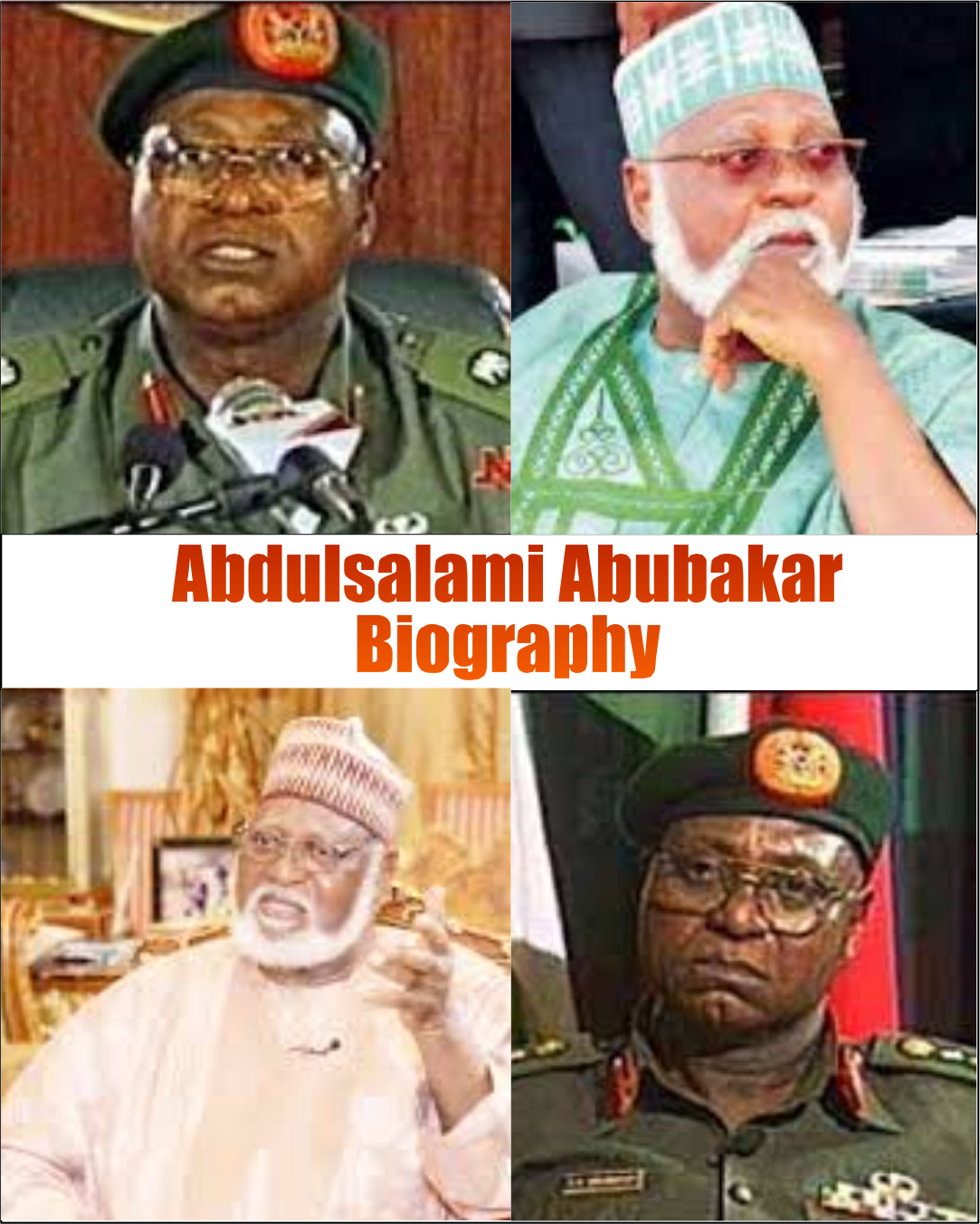
The Abdulsalami Abubakar Biography: The Quiet General Who Stepped In to Stabilized a Nation and Stepped Back.
Discover how Abdulsalami Abubakar navigated Nigeria’s most fragile transition period, balancing military control with a swift return to civilian rule.
Power is often taken.
Rarely is it given up willingly.
In the history of military leadership, there are countless examples of generals who held on—tightening control, extending influence, resisting transition.
Abdulsalami Abubakar did the opposite.
He stepped into power at one of Nigeria’s most uncertain moments.
Stabilized the system.
And then stepped away.
Abdulsalami Abubakar Biography
| Full Name | Abdulsalami Alhaji Abubakar |
|---|---|
| Date of Birth | June 13, 1942 |
| Place of Birth | Minna, Niger State, Nigeria |
| Nationality | Nigerian |
| Profession | Military Officer, Statesman |
| Known For | Former Head of State of Nigeria |
| Education | Nigerian Military Training Institutions |
| Net Worth | Not publicly disclosed |
| Marital Status | Married |
See also: Mo Ibrahim Biography – The Billionaire Who Walked Away from Profit to Fix African Leadership
Early Life and Enlistment Story
Abdulsalami Abubakar’s early years in Northern Nigeria were shaped by discipline and a structured upbringing.
He joined the Nigerian Army during a period when the military was central to national affairs.
His training focused on:
- Tactical operations
- Command structure
- Institutional discipline
Over time, he rose steadily through the ranks, building a reputation for professionalism rather than publicity.
Major Engagements and Military Career
Abubakar’s career spanned key periods in Nigeria’s military history, including the aftermath of the Nigerian Civil War.
While not always at the forefront of public narratives, his roles involved:
- Strategic military coordination
- Command responsibilities within structured units
- Participation in maintaining national stability
His experience positioned him within the inner workings of military leadership.
The Turning Point: A Nation in Crisis
Abubakar’s defining moment came in 1998, during a period of national uncertainty following the sudden death of a sitting military ruler.
Nigeria faced:
- Political instability
- Public tension
- Uncertainty about the future of governance
At this critical point, Abubakar assumed leadership.
The expectations were unclear.
The risks were high.
Leadership Under Pressure: Stabilizing Without Escalating
Abubakar’s leadership style during this period was markedly different from many military rulers.
Instead of consolidating long-term control, he focused on:
- Stabilizing institutions
- Reducing political tension
- Preparing for transition
He operated under intense pressure:
- Domestic expectations for change
- International scrutiny
- Internal military dynamics
Balancing these factors required restraint as much as authority.
A Different Kind of “Heroic Act”
In a military context, heroism is often associated with battlefield actions.
But in Abubakar’s case, it took a different form.
His most significant act was:
- Initiating and overseeing a transition to civilian rule
This involved:
- Organizing elections
- Handing over power within a short timeframe
- Avoiding prolonged military governance
In environments where power is rarely relinquished, this decision stands out.
Psychological Pressure of Leadership at the Top
Leading a country during a fragile transition carries immense psychological weight.
Abubakar had to navigate:
- Conflicting interests within the military
- Civilian expectations for democracy
- The risk of instability during change
Such conditions require constant awareness and careful decision-making.
Medals, Honors, and Recognition
Abubakar’s military career earned him recognition within Nigeria’s armed forces.
His role in facilitating a peaceful transition to civilian rule further strengthened his standing.
He is often acknowledged for:
- Stability-focused leadership
- Commitment to national transition
- Avoidance of prolonged military rule
Life After Service
After stepping down, Abubakar transitioned into a quieter public life.
He has remained involved in:
- Diplomatic engagements
- Conflict resolution efforts
- Advisory roles in governance matters
His post-service life reflects continuity in service—without direct control.
Untold Stories Behind the Transition
Much of the internal process behind Nigeria’s transition remains under-documented.
These include:
- Military deliberations during the handover period
- Internal disagreements or pressures
- Key decisions made behind closed doors
Such moments often define outcomes but remain outside public records.
Legacy and National Impact
Abdulsalami Abubakar’s legacy is tied to a single, powerful idea:
Knowing when to step back.
He represents:
- A rare example of voluntary transition from military rule
- Stability in a moment of uncertainty
- Leadership defined by restraint
His actions contributed to shaping Nigeria’s democratic trajectory.
Memorable Closing
Abdulsalami Abubakar did not build his legacy through prolonged control.
He built it through timing.
Through understanding that leadership is not just about taking charge—but about knowing when to let go.
In a system where power often lingers, he made it temporary.
And in doing so, he changed the direction of a nation.
Because sometimes, the strongest move a leader can make…
is to step aside.
Frequency Asked Questions
What is Abdulsalami Abubakar known for in Nigeria’s history?
Abdulsalami Abubakar is known for serving as Nigeria’s Head of State from 1998 to 1999 and overseeing a peaceful transition from military rule to democratic governance.
How long did Abdulsalami Abubakar serve as Head of State?
Abdulsalami Abubakar served as Nigeria’s Head of State for about one year, from June 1998 to May 1999.
What major achievement is associated with Abdulsalami Abubakar’s leadership?
His most notable achievement was organizing and successfully handing over power to a democratically elected civilian government in 1999.
What roles has Abdulsalami Abubakar played after leaving office?
After leaving office, Abdulsalami Abubakar has been active in international diplomacy and peace mediation efforts across Africa and beyond.
What is Abdulsalami Abubakar’s legacy?
He is widely respected for prioritizing national stability and democracy, and for ensuring a smooth transition that shaped Nigeria’s modern political landscape.