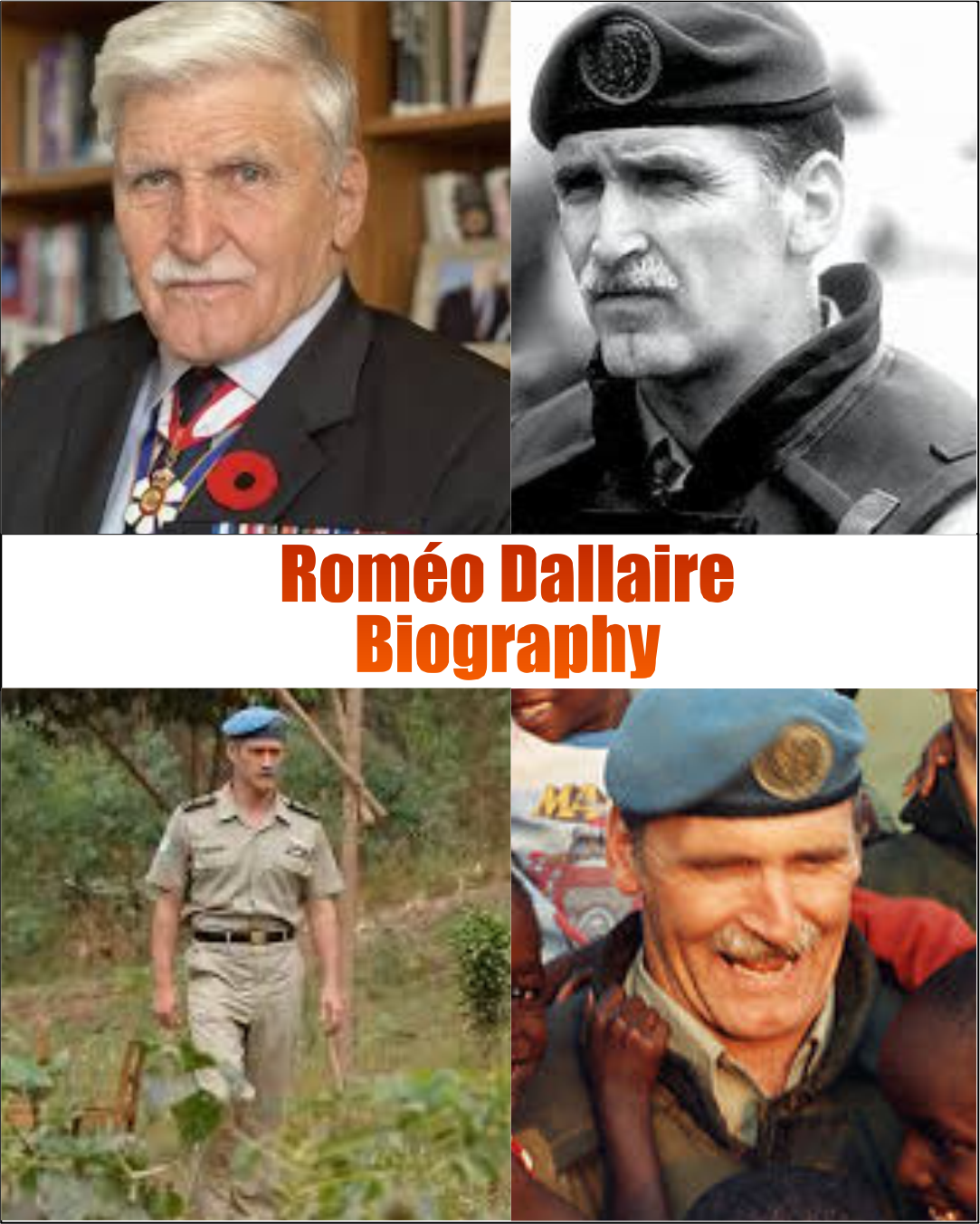
Roméo Dallaire Biography
The Roméo Dallaire Biography: Stopped a Genocide and Carried the Burden for Life
Discover how Roméo Dallaire led UN peacekeeping forces during the Rwandan Genocide, faced impossible choices, and lived with the psychological aftermath.
Some battles are lost before they begin.
Not because soldiers fail—but because the system around them does.
Roméo Dallaire was sent to Rwanda on a peacekeeping mission.
What he found was something entirely different.
And what followed would become one of the most painful chapters in modern military and humanitarian history.
Roméo Dallaire Biography
| Full Name | Roméo Antonius Dallaire |
|---|---|
| Date of Birth | June 25, 1946 |
| Place of Birth | Denekamp, Netherlands |
| Nationality | Canadian |
| Profession | Military Officer, Author, Humanitarian |
| Known For | Force Commander of UNAMIR during the Rwandan Genocide |
| Education | Royal Military College of Canada |
| Net Worth | Not publicly disclosed |
| Marital Status | Married |
See also: Benedict Oramah Biography: The Banker Who Reimagined and Reshaped Africa
Early Life and Enlistment Story
Roméo Dallaire’s path into the military began in Canada, where he pursued a career grounded in discipline, structure, and international service.
He trained as an officer and rose steadily through the ranks, developing expertise in command and operations.
His early career was defined by professionalism and preparation—qualities that would later be tested under unimaginable conditions.
Major Engagement: The Rwandan Genocide
Dallaire’s defining role came as the Force Commander of the United Nations Assistance Mission for Rwanda.
The mission was intended to:
- Monitor a fragile peace agreement
- Maintain stability
- Prevent escalation
But as tensions grew, it became clear that Rwanda was heading toward mass violence.
Dallaire reportedly sent urgent warnings to the United Nations about preparations for large-scale killings.
Those warnings were not acted upon with the urgency required.
Heroic Efforts in an Impossible Situation
When the genocide began, Dallaire faced an impossible reality:
- Limited troops
- Restrictive rules of engagement
- No reinforcement
Despite these constraints, he made critical decisions to:
- Protect as many civilians as possible
- Maintain safe zones
- Keep peacekeepers deployed rather than withdrawing
These actions saved lives—but could not stop the scale of the violence.
His leadership in those moments is often described as operating under conditions where success was structurally limited.
Survival in the Face of Moral Collapse
The Rwandan Genocide was not just a military crisis—it was a moral collapse.
Dallaire and his forces witnessed:
- Mass killings
- Civilian targeting
- Systematic violence on an unprecedented scale
Survival in this context meant enduring not only physical danger, but the psychological impact of witnessing events beyond control.
Leadership Under Extreme Constraint
Dallaire’s leadership was defined not by power—but by limitation.
He had to:
- Make decisions without adequate support
- Operate within strict UN mandates
- Balance action with restrictions
This created a constant tension between what he could do—and what needed to be done.
It is one of the clearest examples of how leadership can be constrained by institutional boundaries.
Psychological Struggles and Aftermath
After the mission, Dallaire faced severe psychological consequences.
He has openly spoken about:
- Post-traumatic stress disorder
- Depression
- The lasting impact of the events in Rwanda
His experience highlights a critical but often overlooked reality:
Military service does not end when deployment ends.
For some, the battle continues internally.
Medals, Honors, and Recognition
Dallaire received recognition for his service and later for his advocacy work.
He has been honored for:
- His role in Rwanda
- His efforts to raise awareness about genocide prevention
- His work on mental health for veterans
His recognition reflects both his actions during the mission and his contributions afterward.
Life After Service
Following his military career, Dallaire transitioned into advocacy and public service.
He became a voice for:
- Human rights
- Conflict prevention
- Veteran mental health
He has written and spoken extensively about his experiences, helping to document one of the most difficult peacekeeping missions in history.
Untold Stories and Institutional Failures
The Rwanda mission revealed significant gaps within international systems.
Many aspects remain debated:
- Why warnings were not acted upon
- Why reinforcements were delayed
- How decision-making processes failed
Dallaire’s story sits within this larger context—where individual effort collided with institutional limitation.
Legacy and Global Impact
Roméo Dallaire’s legacy extends far beyond Rwanda.
He represents:
- The human cost of peacekeeping failure
- The importance of early intervention in conflict
- The psychological impact of command under extreme conditions
His experience has influenced global discussions on:
- Genocide prevention
- Rules of engagement in peacekeeping
- Support systems for veterans
Memorable Closing
Roméo Dallaire did not fail in Rwanda.
He was placed in a situation where failure had already been set in motion.
And yet, within those limits, he chose to act—to stay, to protect, and to bear witness.
His story is not just about war.
It is about responsibility, memory, and the weight of decisions that outlive the battlefield.
Because sometimes, the hardest burden a commander carries is not defeat.
It is survival.
Frequently Asked Questions
What is Roméo Dallaire best known for?
Roméo Dallaire is best known for serving as the Force Commander of the United Nations Assistance Mission for Rwanda (UNAMIR) during the 1994 Rwandan Genocide.
What challenges did Roméo Dallaire face in Rwanda?
Roméo Dallaire faced severe limitations in resources, lack of international support, and restrictions on military intervention while trying to prevent mass killings during the genocide.
What has Roméo Dallaire done after his military career?
After retiring from the military, Roméo Dallaire became an author, humanitarian, and advocate for human rights, focusing on preventing genocide and the use of child soldiers.
Has Roméo Dallaire written any books?
Yes, Roméo Dallaire authored several books, including Shake Hands with the Devil, which details his experiences during the Rwandan Genocide.
What honors has Roméo Dallaire received?
Roméo Dallaire has received numerous awards and honors for his service and humanitarian efforts, recognizing his courage and advocacy for global peace and human rights.