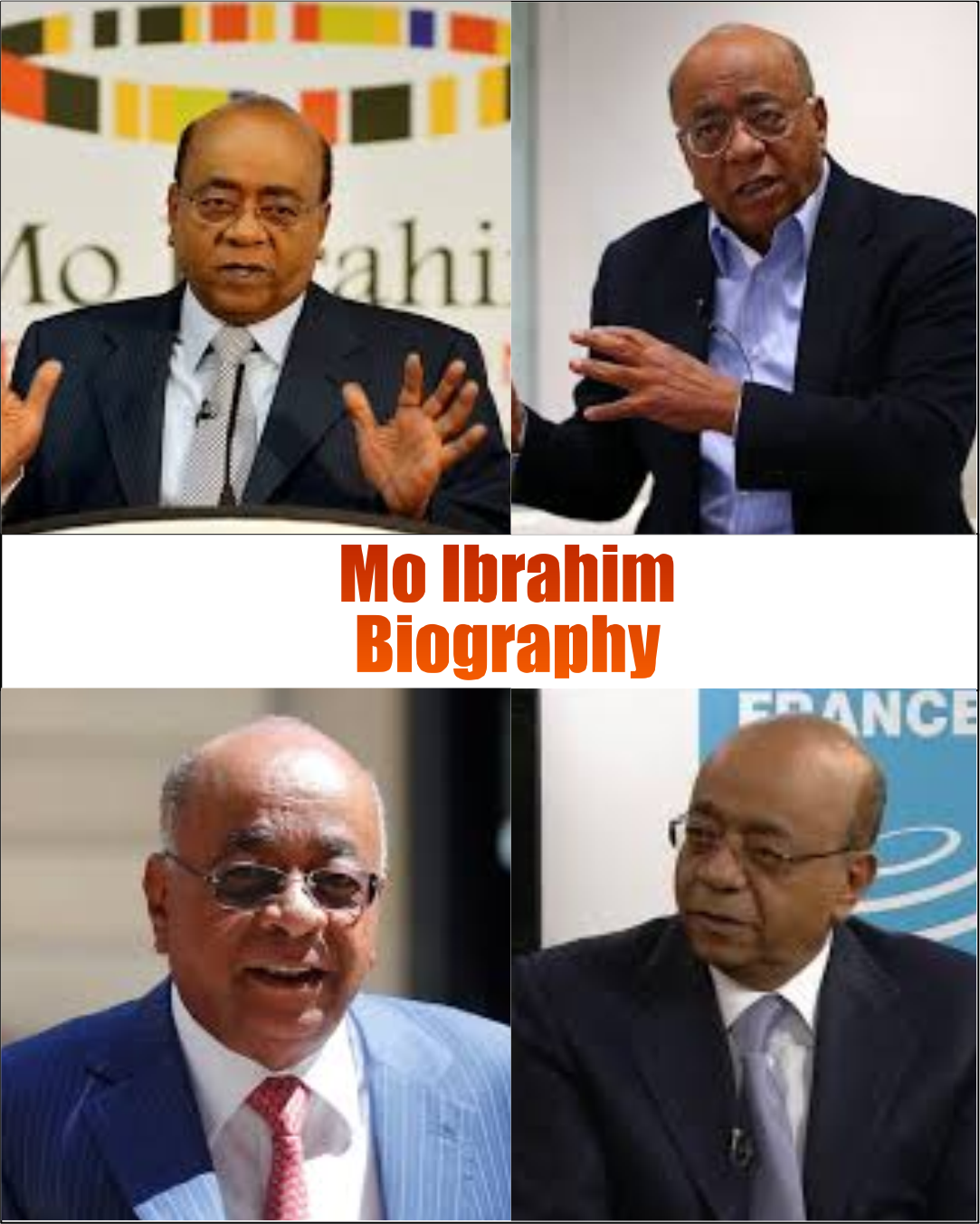
Mo Ibrahim Biography
The Mo Ibrahim Biography – The Billionaire Who Walked Away from Profit to Fix African Leadership.
The Unusual Billionaire with a Different Mission
In the world of business, billionaires are often defined by how much they accumulate. Mohamed Ibrahim, widely known as Mo Ibrahim, is defined by what he chose to give away—and more importantly, what he chose to stand for.
Born in Sudan and educated in the United Kingdom, Ibrahim built one of Africa’s most successful telecommunications companies, Celtel International, at a time when the continent’s mobile network infrastructure was nearly nonexistent. Yet, what makes his story truly remarkable is not just the wealth he created, but the moment he decided that profit alone was not enough.
After selling Celtel for billions, Ibrahim shifted his focus toward a deeper challenge—governance and leadership in Africa. His journey is a rare blend of business success, ethical conviction, and a relentless pursuit of systemic change.
Mo Ibrahim Biography
| Category | Insight |
|---|---|
| 1. Core Business Domain | Telecommunications (Mobile Infrastructure in Emerging Markets) |
| 2. Primary Income Streams | Telecom company exits, investment returns, foundation-backed influence capital |
| 3. Estimated Net Worth Range | ~$1B – $2B |
| 4. Key Companies / Assets | Celtel International (sold to MTC/Zain), Satya Capital, Mo Ibrahim Foundation |
| 5. Signature Strategy | “Build Infrastructure → Scale Regionally → Exit at Peak Value” — focuses on underserved markets with massive growth potential |
| 6. Risk Appetite Level | High (but calculated) — enters politically and economically unstable regions with structured risk mitigation |
| 7. Leadership Style | Systems Builder + Governance Advocate — combines business execution with institutional reform |
| 8. Philanthropy / Social Impact Model | Governance-driven philanthropy (Mo Ibrahim Prize, African leadership accountability systems) |
| 9. Growth Philosophy / Wealth Principle | Sustainable wealth is built by solving large-scale structural problems, then reinvesting gains into governance and long-term stability |
Breakthrough Moment / Turning Point
Mohamed Ibrahim’s breakthrough moment came with the founding of Celtel International in 1998. At the time, Africa’s telecommunications landscape was fragmented, underdeveloped, and often hindered by political instability.
Many investors viewed Africa as too risky. Ibrahim saw opportunity.
He recognized that mobile communication could transform lives by:
- Connecting remote communities
- Enabling business transactions
- Supporting economic development
Celtel quickly expanded across multiple African countries, focusing on regions that were often overlooked by global telecom giants. His commitment to transparency and ethical business practices set Celtel apart in an industry often challenged by corruption.
However, the true turning point came in 2005, when Ibrahim sold Celtel for approximately $3.4 billion. For many entrepreneurs, this would mark the peak of success. For Ibrahim, it marked a new beginning—a shift from building wealth to addressing the deeper structural issues affecting Africa.
See also: Strive Masiyiwa Biography – The Relentless Visionary Who Defied Power to Build Africa Telecom Empire
Business Philosophy / Vision
Mohamed Ibrahim’s philosophy is rooted in integrity, transparency, and long-term impact. Unlike many business leaders who focus solely on expansion and profit, Ibrahim emphasizes ethical responsibility and systemic change.
His core beliefs include:
- Business must be ethical: Transparency and accountability are non-negotiable
- Profit is a means, not an end: Wealth should be used to create broader societal impact
- Leadership matters: Good governance is essential for sustainable development
- Africa’s potential is immense: With the right leadership, the continent can thrive
Ibrahim’s vision extends beyond business success. He believes that Africa’s greatest challenge is not lack of resources, but lack of effective leadership and governance.
Signature Work / Company / Product
Mohamed Ibrahim’s legacy is built on two major pillars:
1. Celtel International
- One of Africa’s first major mobile telecommunications companies
- Operated in over a dozen African countries
- Focused on underserved and high-risk markets
- Known for ethical business practices and transparency
Celtel played a critical role in:
- Expanding mobile access across Africa
- Supporting economic growth
- Enabling communication in previously disconnected regions
2. Mo Ibrahim Foundation
- Founded in 2006 after the sale of Celtel
- Focuses on improving governance and leadership in Africa
- Known for the Ibrahim Prize for Achievement in African Leadership, one of the world’s largest individual awards
The foundation also produces the Ibrahim Index of African Governance, a tool used to measure and analyze governance performance across the continent.
Challenges, Failures, and Controversies
Mohamed Ibrahim’s journey has been shaped by significant challenges.
Operating in High-Risk Markets
Building Celtel required navigating:
- Political instability
- Regulatory uncertainty
- Infrastructure limitations
Ethical Stance in Difficult Environments
Maintaining transparency in regions with high levels of corruption was not easy. Ibrahim insisted on:
- Refusing to pay bribes
- Maintaining strict ethical standards
This approach sometimes slowed expansion but ultimately strengthened the company’s reputation.
Criticism of African Leadership
Through his foundation, Ibrahim has been openly critical of governance failures in Africa. This has:
- Sparked important conversations
- Attracted criticism from political figures
However, he has remained consistent in his commitment to accountability and reform.
Innovations and Impact
Mohamed Ibrahim’s impact spans both business and governance.
1. Telecom Expansion
Through Celtel, he:
- Brought mobile connectivity to millions
- Enabled communication across remote areas
- Supported the growth of mobile-based services
2. Ethical Business Model
He demonstrated that:
- Transparent operations are possible in challenging environments
- Ethical practices can coexist with profitability
3. Governance Reform
Through the Mo Ibrahim Foundation, he has:
- Encouraged accountability among African leaders
- Promoted data-driven governance
- Recognized excellence in leadership
4. Thought Leadership
Ibrahim is a global voice on:
- African development
- Leadership accountability
- Economic transformation
Recognition and Achievements
Mohamed Ibrahim has received numerous global honors:
- Ranked among the world’s most influential people
- Recipient of major international awards for leadership and philanthropy
- Recognized by global institutions for his contributions to business and governance
- Awarded honorary degrees from leading universities
These recognitions reflect his dual impact as both a business leader and a reform advocate.
Net Worth / Financial Success
As of recent estimates:
- Net worth: Approximately $1.1 billion – $1.3 billion
- Primary source: Sale of Celtel and subsequent investments
However, Ibrahim’s financial story is unique because he has chosen to channel much of his wealth into philanthropic initiatives, particularly through his foundation.
Leadership and Management Style
Mohamed Ibrahim’s leadership style is defined by principles, clarity, and courage.
- Ethical leadership: Prioritizes transparency and accountability
- Long-term focus: Builds systems rather than short-term gains
- Direct communication: Speaks openly about challenges and solutions
- Purpose-driven approach: Aligns business and social impact
He is known for leading with conviction, even when it is unpopular.
Influence on Others / Legacy
Mohamed Ibrahim’s legacy is both profound and far-reaching.
- He has influenced how business is conducted in Africa, emphasizing ethics and transparency
- Through his foundation, he has reshaped conversations around governance and leadership
- He has inspired entrepreneurs to think beyond profit and consider long-term societal impact
His work has also:
- Encouraged accountability among leaders
- Provided tools for measuring governance
- Highlighted the importance of responsible leadership
Redefining Success Beyond Wealth
Mohamed Ibrahim’s journey challenges traditional definitions of success. While he achieved extraordinary financial success through Celtel, his true legacy lies in his decision to address deeper systemic issues affecting Africa.
He demonstrates that business leaders can play a critical role not only in economic growth but also in shaping governance, accountability, and societal progress.
For aspiring entrepreneurs and leaders, his story offers powerful lessons:
- That integrity is a competitive advantage
- That success is not just about accumulation, but contribution
- That real impact comes from solving the problems others avoid
In a world where wealth often defines influence, Mohamed Ibrahim stands as a reminder that true leadership is measured by the change you create.
Frequently Asked Questions
1. How did Mo Ibrahim build his wealth?
He built his fortune through Celtel International, one of Africa’s first major mobile networks. By entering underserved African markets early, scaling rapidly across multiple countries, and exiting at a strategic peak, he converted infrastructure into billion-dollar value.
2. What makes his business strategy unique?
His approach combines:
- First-mover advantage in neglected markets
- Pan-African scalability
- Exit discipline (selling at the right time)
Unlike many founders, he did not overstay ownership, allowing him to secure a massive, clean exit.
3. Why is Mo Ibrahim heavily associated with governance rather than just business?
After achieving financial success, he redirected focus toward fixing systemic issues—especially leadership and governance in Africa. Through the Mo Ibrahim Foundation, he promotes accountability, transparency, and effective leadership.
4. What key lesson can entrepreneurs learn from his model?
Target large, structural gaps (like telecom access), not just small market opportunities. True scale—and billion-dollar outcomes—often come from solving infrastructure-level problems that affect entire economies.
5. What defines his long-term impact?
His legacy operates on two levels:
- Economic: Pioneering Africa’s telecom revolution
- Institutional: Elevating governance standards through incentives and accountability frameworks
He transitioned from wealth creator to systems reformer, which significantly amplifies his influence beyond business.